Home
Survey research has a measurement problem it cannot see. A telephone or web survey records the answer and nothing else: not the hesitation before it, not where the respondent was looking, not whether they understood the question. At the same time, conventional face-to-face interviewing is under pressure from attrition, recruitment difficulty and rising cost.
FACES responds to both. It builds a multimodal data space for survey research in which interviews are conducted between avatars in virtual reality or over video, with the full interaction (speech, gaze, posture, facial expression, answers and their timing) captured on a single clock and stored as a linked, relational dataset. The environment is variable by design: avatars, situational parameters, interfaces and AI components can all be manipulated as experimental conditions.
The project is run jointly by the Text Technology Lab at Goethe University Frankfurt and Departments 2 and 3 of the Leibniz Institute for Educational Trajectories (LIfBi) in Bamberg.
Three research questions
FACES asks whether avatar-mediated interviewing is feasible, whether respondents accept it, and whether the resulting data quality holds up.
Avatars versus video
What are the advantages of avatar-based interviews compared to video-based interviews in terms of acceptance, feasibility and data quality?
Reducing interviewer effects
Which combinations of features reduce interviewer effects, and how do they interact?
Virtual interviewer training
How can the results be integrated into a theory for training virtual interviewers?
What has been delivered
Four pieces of open-source software, two completed studies, a reproducible analysis pipeline and two papers. Everything below is public.
InterView
The interview platform. VR and browser clients, a WebRTC media layer, a room server and a logging API, shipped as one Docker Compose stack.
Platform → ReleasedVa.Si.Li-Lab
The Unity VR framework InterView is built on, together with its backend: scene and role definitions, the Ubiq room server and the logging API.
Framework → ReleasedJanus-Gateway
A pinned, reproducible build of the Janus WebRTC server, so you can state which software produced a dataset.
Infrastructure → CompleteAvatar pre-study
99 respondents rated 20 avatars on preference, trust, comfort and similarity, to select the interviewer avatars used in the main study.
Study 1 → CompleteVR interview study
27 full interviews conducted in virtual reality across two institutions, with the complete multimodal record of each one.
Study 2 → CompleteAnalysis pipeline
Every figure, table and reported number regenerates from cache with one command, and the prose is read back out of the written tables.
Reproducibility → AcceptedReEmote
Emotion representation in VR through avatar facial expression. Accepted at XR Salento 2026, Springer LNCS.
Publication → Under reviewInterView paper
Towards a Unified VR-Capable Interview Environment: the system, its data model, and the evaluation study. Under review at IJHCS (Elsevier); preprint on SSRN.
Publication →records captured across six linked modalities in 27 interviews (eye, body and head tracking, audio, transcribed speech, questionnaire state and self-report), at a measured median of 18.5 Hz with a 96.6 % capture duty cycle. Not a nominal specification: a measurement, read back out of the stored data.
How it works
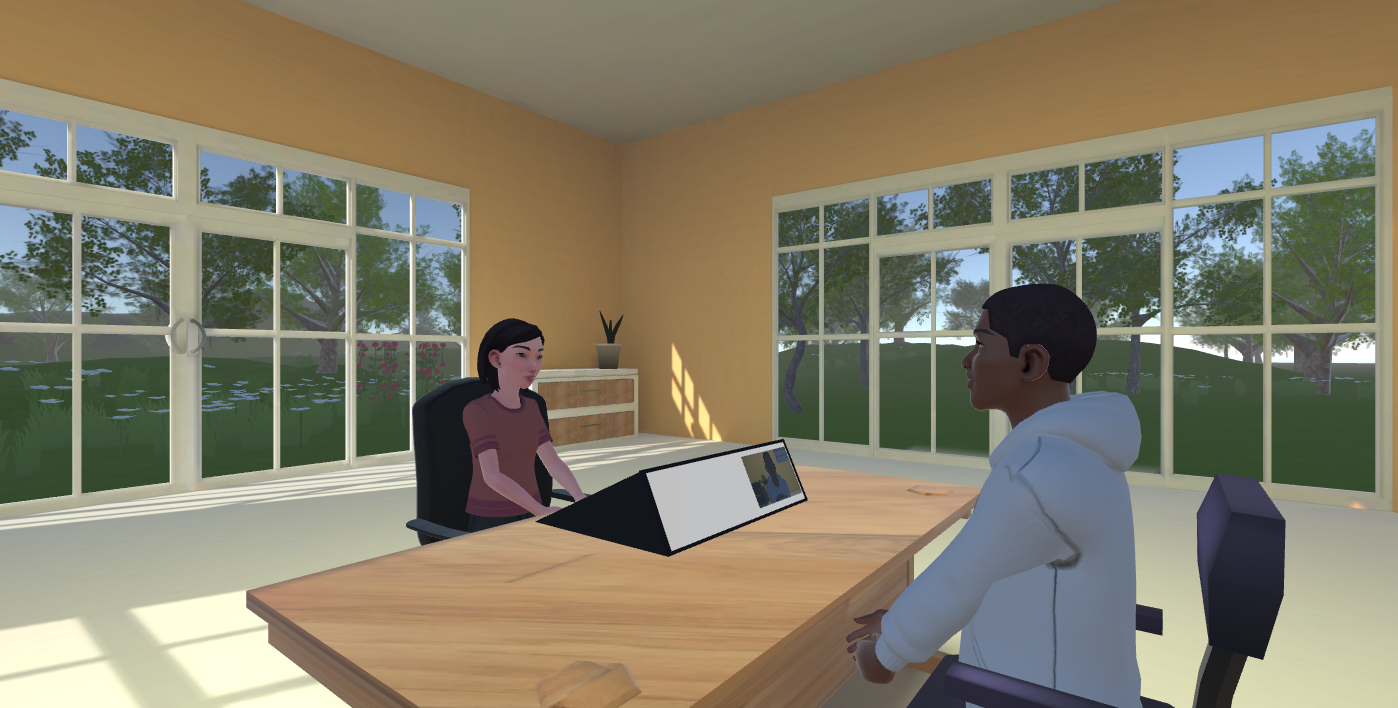
An interviewee wears a VR headset and sits across a desk from an avatar in a shared virtual room. The interviewer sits at an ordinary web browser. A live audio and video link connects them, a questionnaire is embedded in the environment itself, and everything that happens is recorded time-aligned into a single relational dataset.
The approach runs in three stages. The platform was built first and is now released; the preliminary experiments on avatar characteristics and immersion are complete; validation with former NEPS panel participants is now under way.