Deliverables
Everything FACES has built is open source and public. Four repositories, each with its own documentation site; this page explains how they fit together.
| Component | What it is | Repository | Docs |
|---|---|---|---|
| InterView | The interview platform. A Docker Compose stack that runs the whole system. | texttechnologylab/InterView | Docs · here |
| Va.Si.Li-Lab | The Unity VR framework InterView's headset client is built on. | texttechnologylab/Va.Si.Li-Lab | Docs · here |
| Va.Si.Li-Lab-backend | Scene, level and role definitions, the logging API, the Ubiq room server, and optional chatbot and speech services. | texttechnologylab/Va.Si.Li-Lab-backend | Docs · here |
| Janus-Gateway | A pinned, reproducible container build of the Janus WebRTC server. | texttechnologylab/Janus-Gateway | Docs · here |
How the pieces fit together
flowchart LR
  subgraph clients [Clients]
    direction TB
    VR["InterView-VR<br/>Unity, Meta Quest"]
    WEB["InterView-W<br/>browser"]
    LLM["LLM client"]
  end

  subgraph backend [InterView-B, the backend]
    direction TB
    JANUS["Janus SFU<br/>+ coturn TURN relay"]
    VSL["Va.Si.Li-Lab server<br/>Ubiq rooms and state"]
    QUEST["Questionnaire<br/>LimeSurvey"]
  end

  DB[("Logging API<br/>database")]

  subgraph proc [InterView-P, processing]
    direction TB
    ASR["ASR, Whisper"]
    GAZE["Gaze AOI replay"]
  end

  REL["Relational dataset"]
  DUUI["DUUI<br/>distributed processing"]

  VR --> JANUS
  WEB --> JANUS
  LLM -.-> JANUS
  VR --> VSL
  WEB --> VSL
  VSL --> QUEST
  JANUS --> DB
  VSL --> DB
  QUEST --> DB
  DB --> ASR
  DB --> GAZE
  ASR --> REL
  GAZE --> REL
  REL --> DUUI

  classDef planned stroke-dasharray: 5 4,stroke:#E5007D,color:#E5007D;
  class LLM planned;
Clients of any type join a room. Janus negotiates the audio and video streams between them and carries a control data channel; the Va.Si.Li-Lab server synchronises the environment, the avatars and the state of the questionnaire. Everything either of them produces is written through the logging API. InterView-P then collects each completed interview, transcribes the audio, resolves gaze against the geometry of the scene, imports the questionnaire responses, and links them all into one relational dataset, which can be handed on to DUUI for distributed multimodal processing.
The LLM client is drawn dashed because it is designed and supported by the backend but was not part of the evaluation study. See requirement (G) on the Project page.
The data model
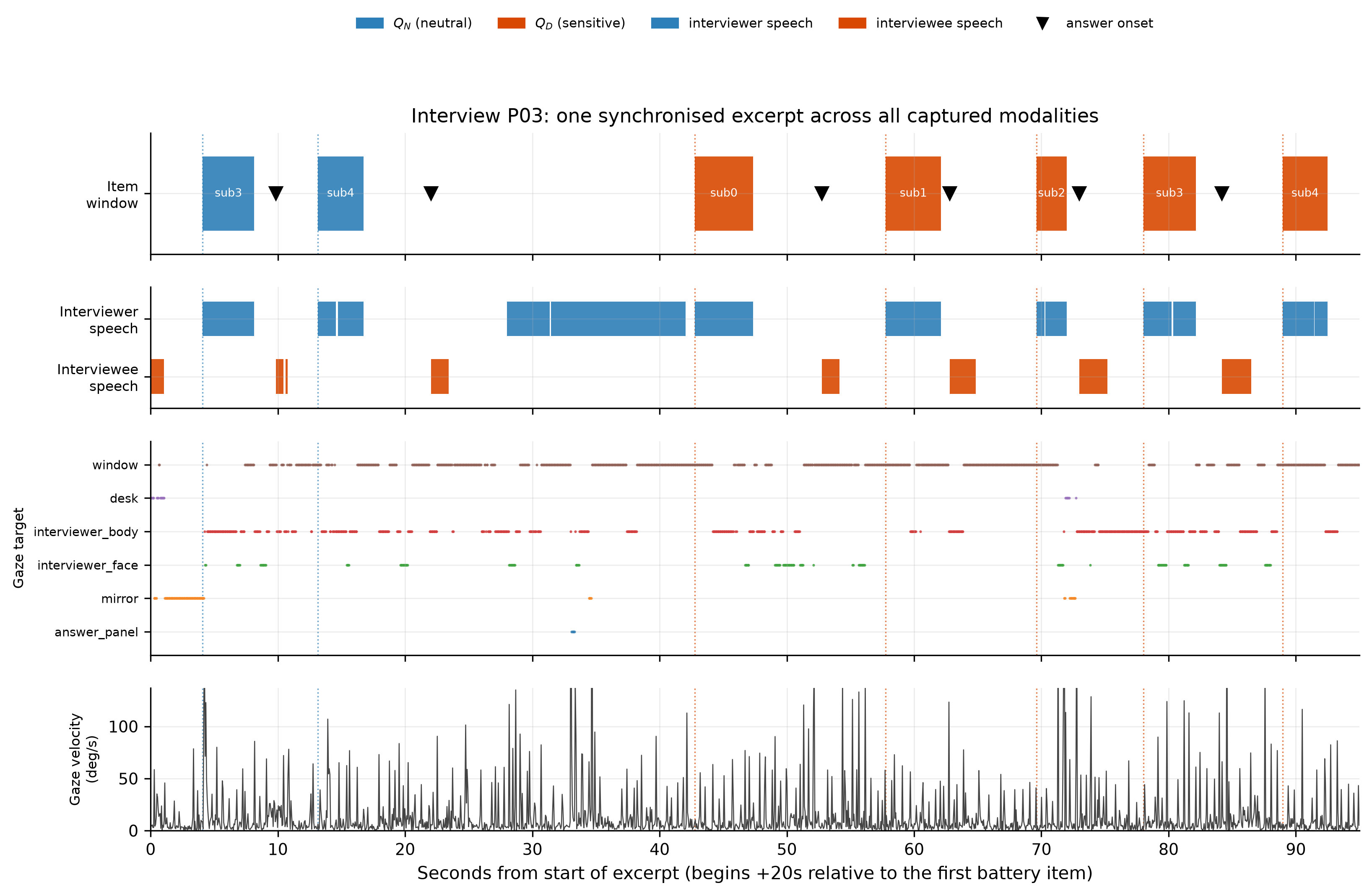
The point of the architecture is what comes out of it. Interview data is not stored as isolated question–answer pairs with metadata attached; questionnaire items, multimodal recordings and contextual signals are nodes, and their temporal and behavioural relations are links.
Because the modalities share a clock and a set of links, questions can be asked across them that no single stream could answer on its own: what a respondent was looking at while answering a particular item, how long they took, whether their fixation pattern shifted, and whether any of that lines up with what they later said about the experience. Studies shows what that makes visible.
Reuse
The stack is designed to be run by other people. A minimal deployment is the
database API, the Ubiq room server and a database instance; the full interview
stack adds Janus, a TURN relay and the web client, and comes up with
docker compose up -d once configured.
Read the setup guide before deploying
The stack requires an external database and a TLS-terminating reverse proxy, and will not work without them. See the InterView setup guide.
If you use any of it, please cite it.